Citizens' Assembly in Jena: Experience City Politics Firsthand
Experience Citizens' Assemblies & City Politics in Jena: What to Expect at the Next Events
If you experience Jena in everyday life, you often have concrete questions: How will traffic be organized in the neighborhood in the future? Where will new housing be built? What changes are planned for schools, daycare centers, green spaces, or public transport? At the upcoming citizens' assemblies, you can bring up these topics directly – publicly, transparently, and close to your neighborhood.
Note: This article describes how future citizens' assemblies will typically proceed and how you can prepare once the city of Jena publishes dates and invitations.
What a Citizens' Assembly in Jena Will Achieve
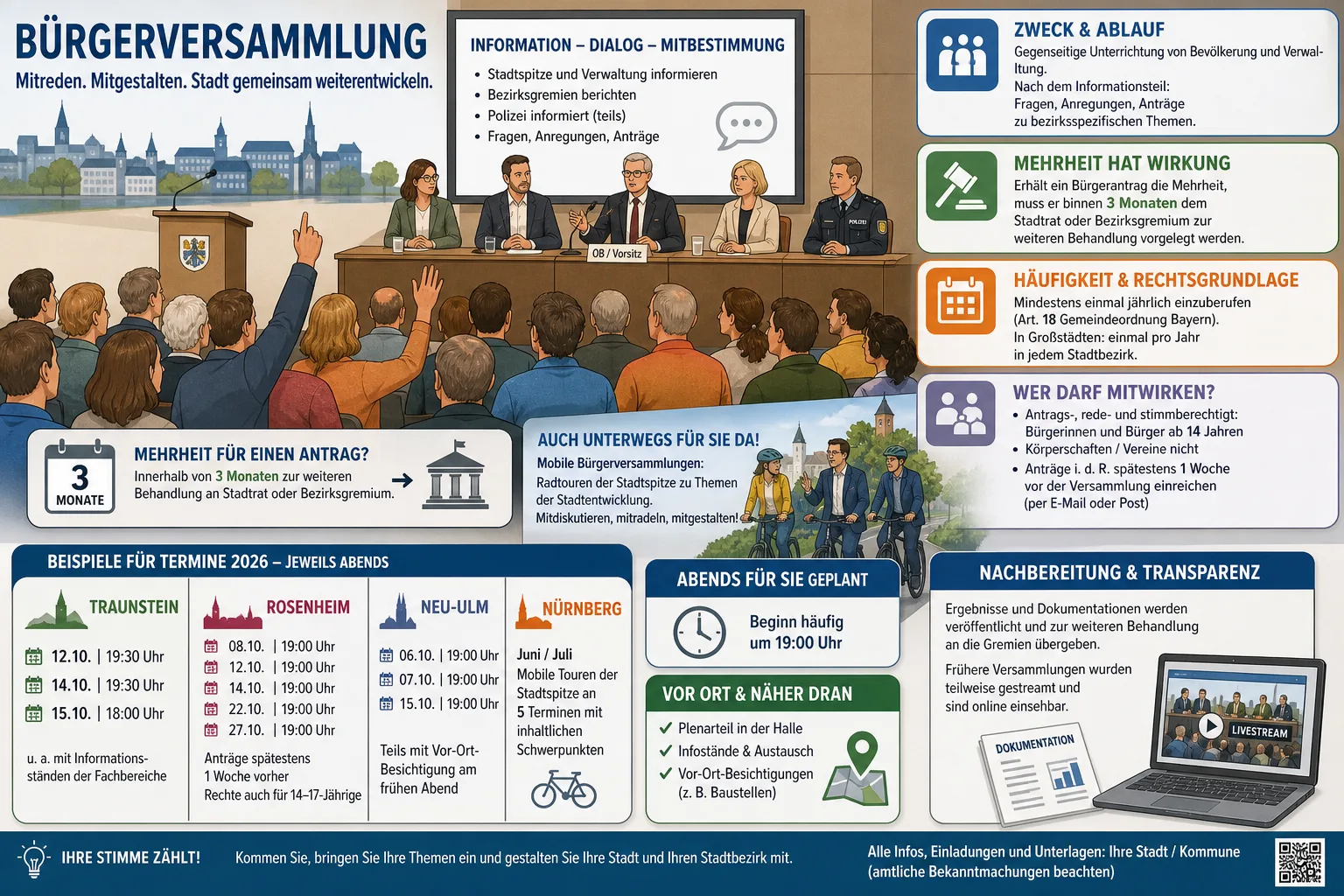
When the city of Jena announces a citizens' assembly, it will function as a public participation format: The administration and city leadership will inform about projects, and residents will be able to ask questions, present concerns, and initiate discussions.
For you, this means above all three concrete opportunities at the next citizens' assembly:
- Orientation: You will learn in a bundled way which projects and plans will affect your neighborhood in the coming period.
- Influence: You will be able to point out where plans are problematic in everyday life (e.g., school routes, noise, crossings, accessibility).
- Binding Process: Your contributions will not remain "just opinions," but will enter a transparent processing track (e.g., forwarding to responsible departments or committees, documentation in the minutes).
Legally, municipal participation in Germany is shaped by municipal self-government; the specific design is determined by state law and municipal regulations. In Thuringia, the framework is set in particular by the Thuringian Municipal Code.
Procedure of the Next Citizens' Assembly: How the Evening Will Be Structured
At a future citizens' assembly in Jena, a clear procedure is expected that enables both information and exchange. Typically, the evening will be divided into these components:
1) Opening and Organizational Notes
At the beginning, the chair (often the city leadership or an appointed person) will explain the structure of the evening: speaking times, order of speakers, handling of interim questions, and how contributions will be recorded.
2) Information Section on Neighborhood Projects
In the information section, announced projects for the coming period will be presented. Typical topics that may be addressed in Jena in the future include:
- Traffic management, parking, cycling and walking
- Public transport planning and construction coordination
- School and daycare development
- Urban development, housing, public spaces
- Safety, order, cleanliness (if announced)
3) Dialogue Section: Questions, Concerns, and Discussion
Afterwards, the audience will have their say. Here, follow-up questions on the presented points will be asked and new topics introduced that are considered urgent in the neighborhood.
4) Conclusion: Next Steps and Follow-Up Information
At the end, a summary will be given of which points were documented, which responsibilities will take effect next, and where you will later find minutes or results (if the city provides for such publications).
Your Role: Right to Speak, Questions, and Motions
At the next citizens' assembly, you will achieve the most if you formulate your contribution clearly, briefly, and concretely. Typical contributions you might make include:
- Clarifying Questions: "When will the measure be implemented?" or "Which options are being considered?"
- Everyday Observations: "At the start of school, crossing here regularly becomes dangerous."
- Suggestions: "A temporary solution until the construction could look like this..."
Whether and how motions can be made or votes taken at the specific citizens' assembly will be determined in the respective invitation or by procedural notes on site. Once the city of Jena publishes the modalities, you will be able to follow them (e.g., whether written submissions are possible in advance or whether a sign-up list is used in the hall).
How to Prepare Effectively for Upcoming Dates
If you attend a future citizens' assembly in Jena, good preparation will make it much easier for you to be heard. These steps will prove effective:
- Concern in One Sentence: Formulate a core sentence in advance ("I want to achieve that ...").
- Observation + Location + Time: Name a specific place and typical situations (e.g., "weekday mornings" instead of "always").
- Impact: Briefly explain who is affected (children, elderly, people in wheelchairs, commuters).
- Suggestion or Question: Conclude with a realistic option or a clear decision question.
- Bundle Support: Talk to neighbors in advance; several short, consistent contributions will have an impact.
If the city provides additional documents for a future date (e.g., presentations, maps, overviews), you will benefit from reading them in advance and noting 2–3 precise follow-up questions.
Which Formats Will Be Possible in the Future (Hall, Neighborhood, Hybrid)
Depending on the topic and organizational framework, future citizens' assemblies will be designed differently. Possible formats that the city may use (depending on the invitation) include:
- Classic Hall Assembly: Good for many participants, clear speaking order, structured recording of minutes.
- Dialogue-Oriented Neighborhood Formats: Short inputs at display boards or maps, then exchange at topic tables.
- On-Site Elements: If site visits are announced, you will be able to discuss plans directly on site (e.g., intersections, construction areas, squares).
- Hybrid Elements: If digital transmission or online questions are offered, you will be able to participate without being present or review content later.
Which format is used will be stated in the respective announcement. For you, regardless of the format: a clear point, a specific location, and a factual question matter.
What Will Happen After the Assembly: Minutes, Responsibilities, Feedback
For participation to build trust, follow-up will be crucial. After a future citizens' assembly, you can typically expect the following results, provided the city publishes them:
- Minutes or Summary of Results with questions, topics, and key statements
- Assignment of Responsibilities (department, municipal company, committee)
- Information on Further Procedure, if points are further discussed in committees or the city council
For your own follow-up, a simple routine will be worthwhile: After the event, note your question in one sentence, the name of the project or keyword, and which office was mentioned. This way, you will be able to check more quickly later whether and where the point is raised again.
Respectful Exchange: Rules That Will Improve Discussions in the Future
For a future citizens' assembly to be useful for as many people as possible, respectful interaction will be crucial. You will be most effective if you:
- stick to verifiable observations (location, situation, impact)
- separate personal from factual issues (critique the problem, not the person)
- let others finish speaking and respect time limits
- ask solution-oriented questions on conflict topics ("Which options are being considered?")
This way, an evening will not just be a debate, but a solid starting point for decisions that will shape your neighborhood in the future.
Sources
- Thuringia State Law (including Thuringian Municipal Code) — Legal framework for municipal participation in Thuringia (accessed 2026-09-30)
- Federal Agency for Civic Education (bpb) — Background knowledge on municipal democracy and participation formats (accessed 2026-09-30)
- Federal Ministry of the Interior and Community (BMI) — Basics of municipal self-government in the context of state order (accessed 2026-09-30)