
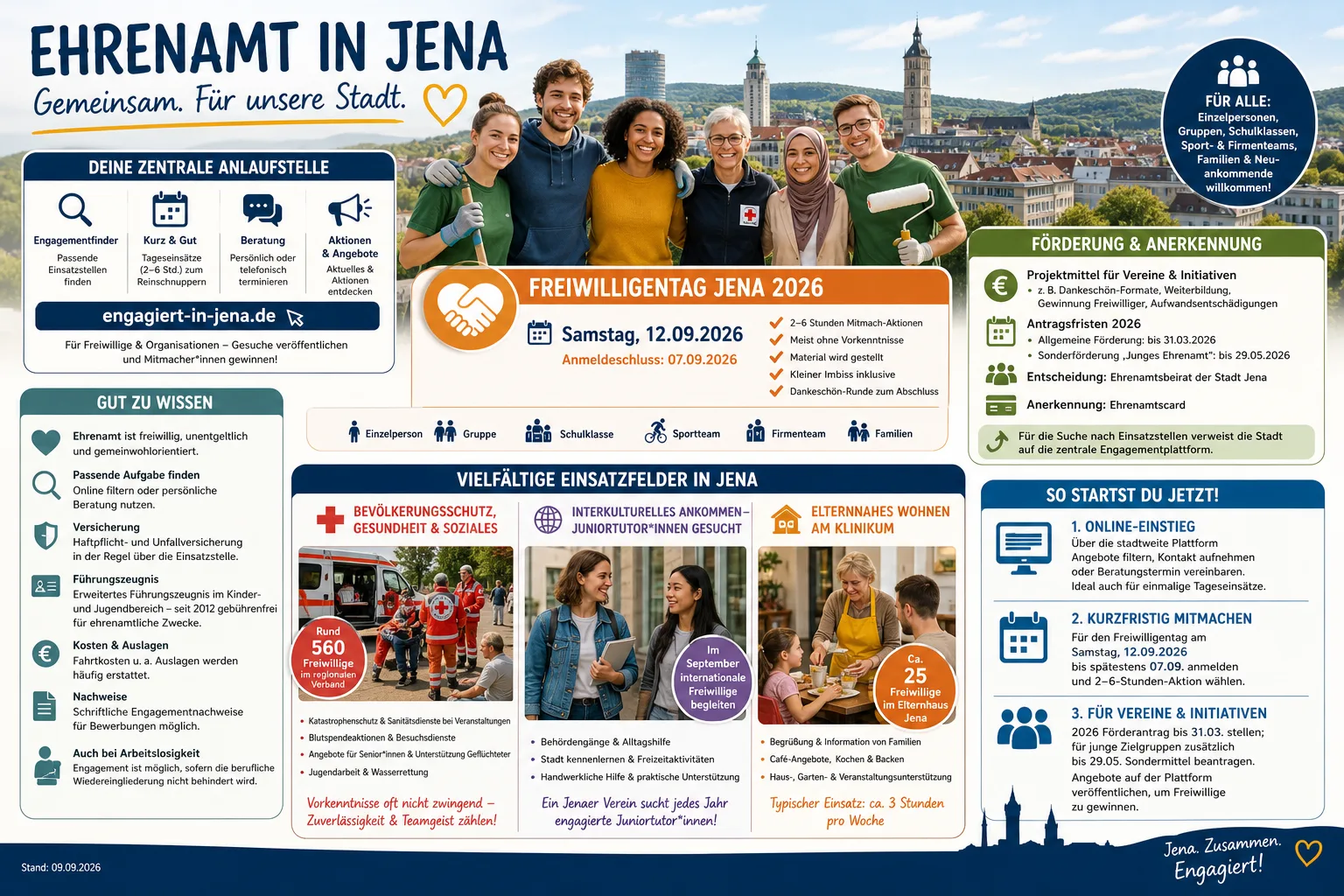
Volunteering in Jena: Here’s Where You Can Get Involved
Volunteering & Volunteer Work in Jena: How to Find the Right Commitment for You in 2026/2027
Whether you want to help out just once or get involved regularly: In Jena, you will continue to find many opportunities in the coming months and next year to engage in meaningful activities – organized, transparent, and usually with low entry barriers.
Why Volunteering in Jena (Still) Remains So Important
Voluntary engagement will continue to be needed in Jena wherever time, attention, and practical help make a difference: in social institutions, in the neighborhood, in projects for the environment and education, as well as in civil protection. Those who get involved not only strengthen specific services but also create encounters – often exactly where “I don’t know anyone” turns into a real network.
At the same time: You don’t have to be “perfect” to get started. Many placements plan their onboarding so that you can first get a taste – with clear tasks, contact persons, and a realistic time commitment.
Jena’s Central Engagement Platform: Your Entry Point
If you want to start volunteering in Jena, a central engagement platform is the obvious first step. There you can soon filter offers specifically – for example by topic (social, culture, environment, sports), time commitment, target group, or location – and then contact the respective organization directly.
How to Use the Search Effectively
- Set your time budget: one-off, project-based, or regular (e.g., 2–3 hours per week).
- Choose a topic area: preferably one that will motivate you in the long term.
- Ask yourself 3 questions in advance: What tasks are specifically planned? What kind of onboarding is there? Who is your contact person?
Many organizations also offer a short get-to-know-you meeting before you commit. This is especially helpful if you are new to Jena or want to get into a new field of activity.
Short & Sweet: Engagement Formats for Little Time
If your everyday life is busy, short assignments will continue to be attractive in Jena: a few hours up to a maximum of one day, clearly defined, often without prior knowledge. Such formats are suitable for trying out volunteering, as a team activity (friends, studies, colleagues), or as an uncomplicated starting point from which a regular volunteer position can later develop.
Typical activities suitable for short assignments include practical support at events, preparatory work, helping out at events, or simple tasks in neighborhood assistance – each supervised and with materials on site.
Volunteer Day in Jena: What to Expect at the Next Event
In the coming years, Volunteer Day will continue to be a particularly easy entry point for many people in Jena: Associations, initiatives, and institutions plan manageable hands-on projects for this, which often last between about two and six hours. You will likely find tasks there that work without specialist knowledge – with a short briefing, clear tasks, and a team spirit.
How to Prepare for the Next Volunteer Day
- Choose a project that realistically fits your day (travel, duration, breaks).
- Clarify the framework conditions in advance: meeting point, clothing, weatherproof equipment, accessibility.
- Go in with a “try-out mindset”: The day is ideal for finding out whether you can imagine getting involved with a topic for a longer period.
If you want to participate as a group (e.g., as a class, team, or circle of friends), it is worth coordinating early and choosing a project that is explicitly advertised for groups.
Well Secured: Framework Conditions You Should Check Before Starting
To ensure that volunteering remains safe and fair for everyone involved, you should – before you commit – always briefly clarify these points in the future:
Insurance & Supervision
Many organizations arrange accident and liability insurance through their internal structures or the responsible sponsor. Explicitly ask which coverage applies during the assignment (including travel to and from, if relevant) and who is responsible during the assignment.
Extended Certificate of Conduct (especially when working with children/youth)
If your assignment involves contact with children or young people, an extended certificate of conduct may be required. For voluntary activities, issuance can be free of charge under certain conditions; for this, you usually need written confirmation from the organization that the certificate is needed for the volunteer work.
Expenses & Expense Allowance
Volunteering is fundamentally voluntary and not aimed at earning income. At the same time, costs may arise during the assignment (e.g., travel expenses). Reputable placements discuss in advance whether and how expenses will be reimbursed. It is best to agree on this in writing or by email – briefly and clearly.
Proof & Certificates
If you would like a certificate for your studies, applications, or qualification records, mention this early on. Many organizations can provide you with a description of your activities, times of service, and, if applicable, completed training sessions in the future.
Fields of Activity in Jena That Will Continue to Frequently Seek Volunteers
1) Civil Protection, Health & Social Services
This area will likely continue to seek people who want to work reliably in a team – for example, to support medical services, information and prevention programs, visiting or escort services, or organizational tasks in the background. You will often receive training before taking on tasks with more responsibility.
2) Intercultural Arrival & Everyday Assistance
Jena remains a place where people arrive anew – through studies, work, or international programs. Future engagement opportunities will therefore continue to include support in everyday life: orientation in the city, accompanying to appointments (depending on the project), practicing German together in everyday life, or leisure activities that promote contact and belonging.
3) Support for Families in Stressful Life Situations
When children or relatives need medical or nursing care for longer periods, families often need relief: through practical help, a calm contact person, small services, or support with offerings around clinics and social institutions. In such assignments, reliability, empathy, and clear boundaries are especially important – with good guidance from the sponsors.
Support & Recognition: What You Can Expect as a Volunteer in the Future
Many municipalities and sponsors will continue to focus on a culture of recognition – for example, through training, networking meetings, thank-you formats, or card and discount models that visibly honor engagement. If you plan your own project or want to support an association, there will often continue to be advisory and funding opportunities in the future (e.g., for qualification, public relations, or recruiting new volunteers).
Important: Good support does not replace professional work – it is meant to complement meaningful projects and make engagement structurally possible.
How to Get Started in the Next Few Weeks
- Find 2–3 suitable offers via the central engagement search and read the task description, time commitment, and requirements.
- Make contact and ask for a short introductory meeting (on site or by phone).
- Clarify the basics: insurance, contact person, onboarding, if applicable certificate of conduct, reimbursement of costs.
- Start with a manageable scope (e.g., a trial appointment or a short assignment) and then decide whether you want to continue.
If you are unsure what suits you, a simple guiding question helps: “What can I realistically start with, without overwhelming myself?” This is exactly how engagements are created that last in the long term.