Cultural Education and Societal Discourse in Jena
Cultural Education & Societal Discourse in Jena (Outlook 2026–2028)
How could a city change if, in the future, children learn in the cultural center, senior women moderate discussion formats, and debates on urban development take place in repurposed industrial areas? For Jena, municipal planning documents and announced participation formats outline a vision of the future in which cultural education is intended to act as a driver for participation, conflict resolution skills, and everyday democracy.
Citizen Participation: How Debates Are to Become More Plannable in the Future
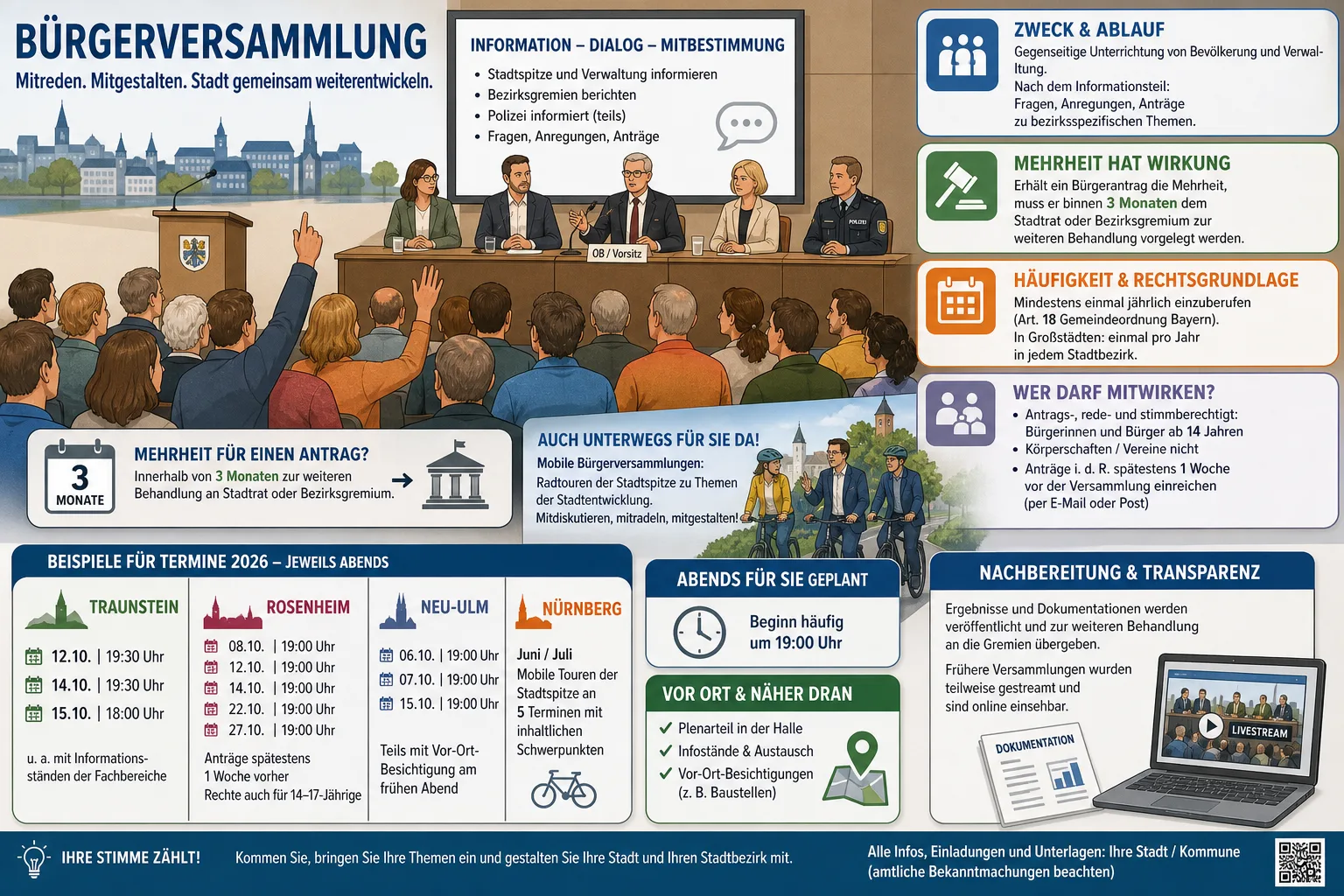
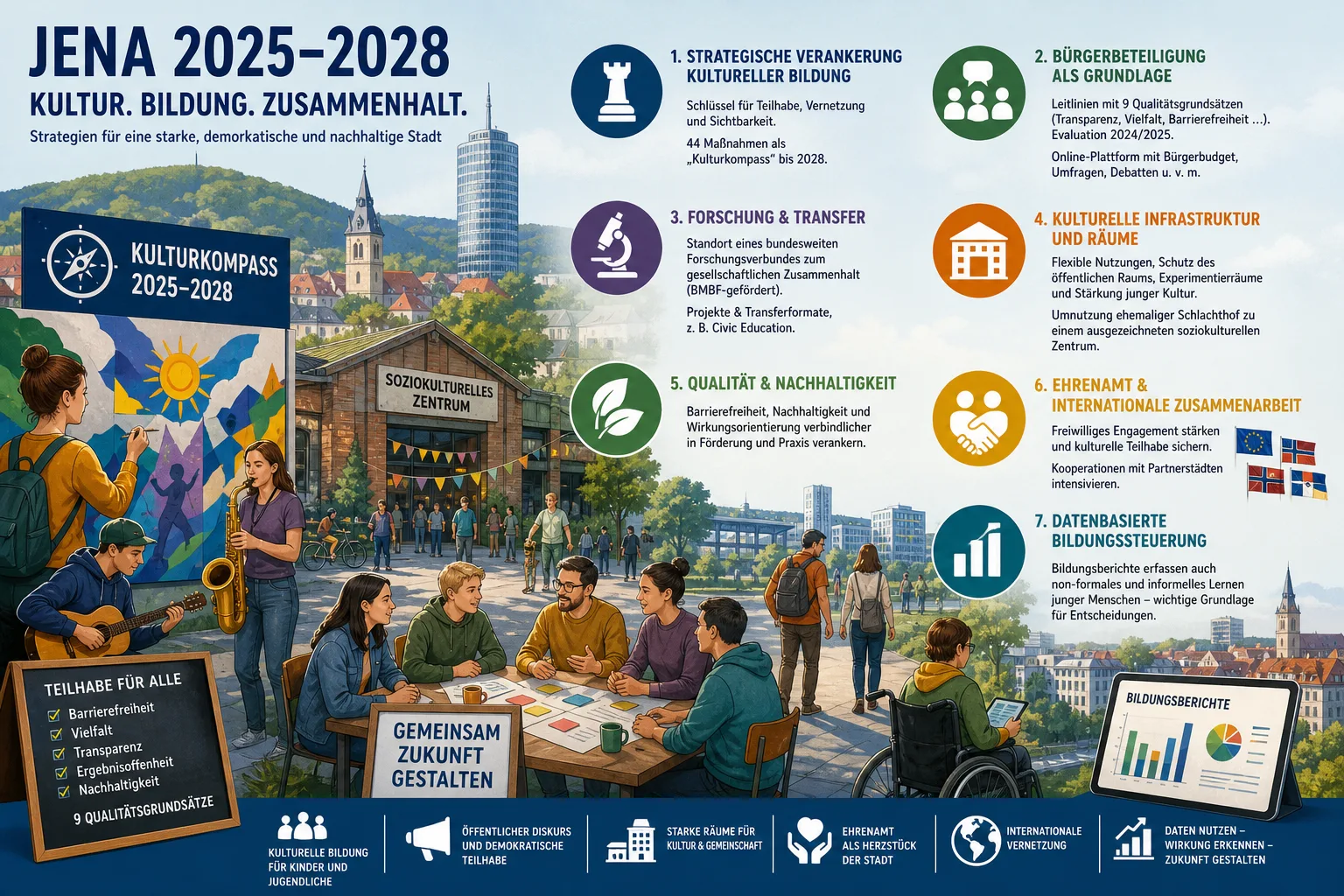
So that societal discourse does not arise only on specific occasions, participation processes in Jena are to be conducted more according to uniform quality criteria in the future. Guidelines for citizen participation and a consolidated presentation of ongoing projects can help ensure that participation is organized early, transparently, and with fewer barriers.
Expected Effects on Discourse 2026–2028
- Plannable Participation: Citizens should be able to recognize more quickly when their perspective is needed, how they can contribute, and where results are documented.
- Reliable Standards: Clear process and documentation rules are intended to increase trust, as contributions do not disappear into the void but are processed in a traceable way.
- Bridges to Cultural Education: Participation formats could more often use cultural methods (e.g., visualization, moderated dialogue spaces, artistically guided city walks) to make complex topics accessible.
If these standards are consistently applied, citizen participation in 2026–2028 can function more as a learning space: people practice exchanging arguments, enduring conflicts, and negotiating compromises.
Science & Transfer: Democracy Education as a Bridge to Urban Society
In the coming years, it can be expected that research on social cohesion and democracy issues in Jena will continue to be translated more visibly into public formats. What matters less is the research itself, but rather the planned transfer: discussion series, cooperation projects, and educational offerings that translate scientific findings into everyday language.
Formats Particularly Suitable for 2026–2028
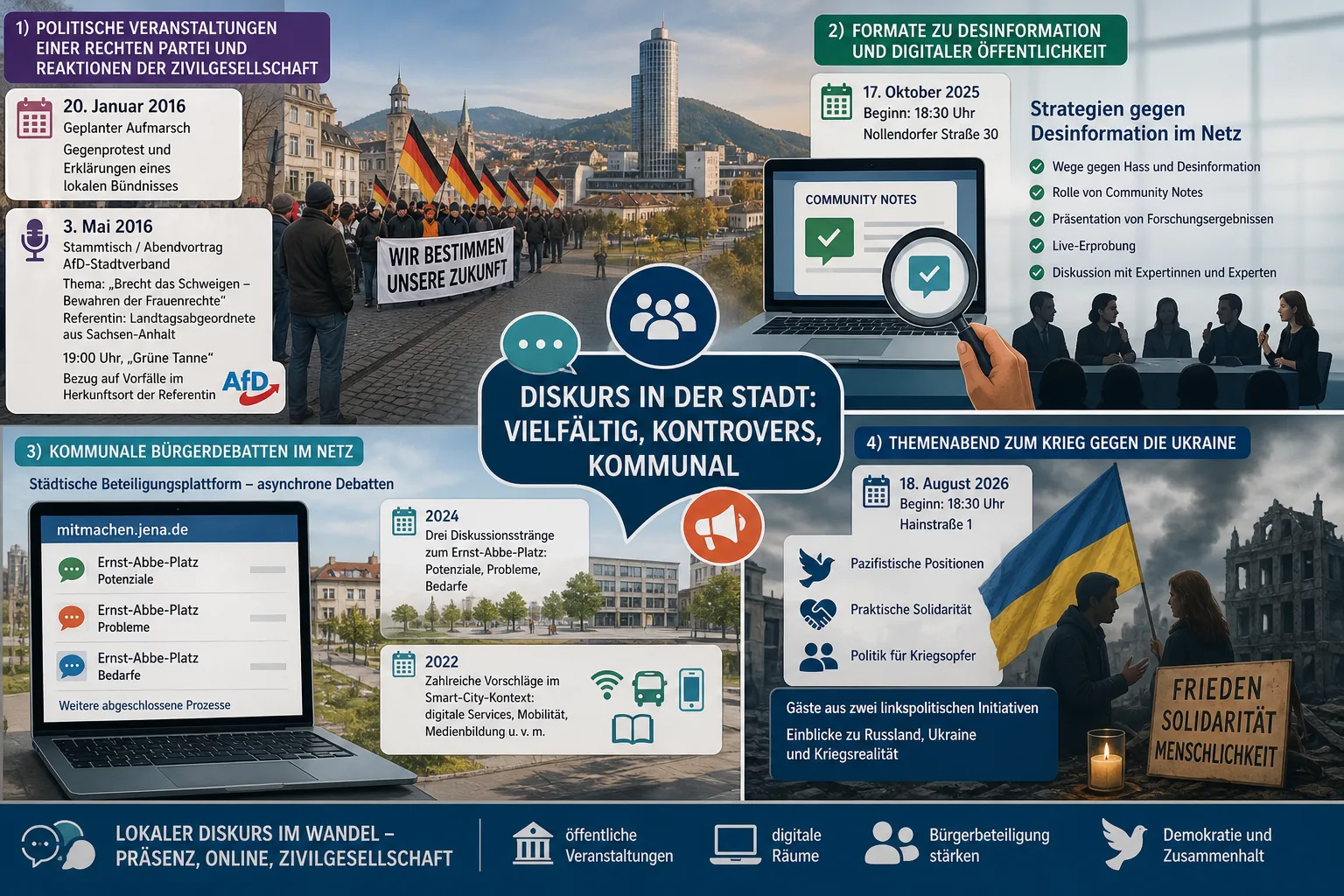
- Public Discussion Series: Discourses on democracy, polarization, culture of remembrance, or migration society can take place in libraries, cultural centers, or educational institutions to lower thresholds.
- Further Education & Qualification: Study and further education offerings in the field of democracy education can practically strengthen multipliers (e.g., educators, cultural mediators, youth workers).
- Cooperation with Cultural Actors: Exhibitions, theater, and media projects can increasingly serve as "translation services": research results become tangible and open for discussion.
This can reinforce a cycle in 2026–2028: analysis provides orientation, cultural education creates access, and participation formats enable feedback into municipal decisions.
Spaces & Socioculture: Experimental Spaces for Learning and Discourse
In the coming years, cultural education will need not only programs but also reliably usable spaces: rehearsal rooms, workshops, stages, open meeting points, and places without a consumption requirement. For 2026–2028, it is expected that flexible use of space, protection of public spaces, and the enabling of temporary experimental spaces will become more important—also because usage conflicts (noise, safety, access) may increase.
Why Sociocultural Places Are Likely to Become Even More Relevant
- Low Entry Barriers: Open formats make it easier for people who rarely find themselves in traditional institutions to participate.
- Mixed Use: When workshop, education, neighborhood, and stage come together, incidental opportunities for learning and discourse arise.
- Conflicts as Learning Material: Moderated dialogue formats can help not to suppress tensions but to negotiate them fairly.
For Jena, this could mean in 2026–2028: more "third places" where cultural mediation, youth work, volunteering, and urban society do not run alongside each other but meet in everyday life.
Quality, Sustainability & Data: How Impact Is to Become More Measurable
So that cultural education does not fizzle out as symbolic politics in the coming years, three steering questions will likely become more important: quality, sustainability, and impact. For 2026–2028, especially more binding criteria in funding and project practice can influence implementation.
Focus Areas Likely to Gain Importance in 2026–2028
- Accessibility: Accessible places, understandable communication, and inclusive formats can increasingly be expected as standard.
- Ecological Sustainability: Production, material use, energy, and mobility can increasingly be evaluated as part of project quality in the future.
- Impact Orientation: In addition to reach, it may become more important what changes in target groups (e.g., self-efficacy, participation, dialogue skills) and how this is documented in a traceable way.
Data-based educational management can help make non-formal and informal learning (e.g., in libraries, music schools, youth clubs, cultural centers) more visible as part of the municipal educational landscape. For 2026–2028, it is plausible that such data foundations will be used more to plan offerings more specifically and distribute resources more fairly.
Cultural Summit 2027: Interim Status and Next Update
A cultural summit is planned for 2027, which is intended to consolidate the implementation status of the cultural concept and initiate the next update. As a future format, it can be particularly effective if it not only takes stock internally within the administration but also makes it publicly understandable what works, where target groups are missing, and which goal conflicts remain unresolved.
Three Guiding Questions That Should Guide Action in 2027
- Spaces & Access: Which places actually opened up new access to cultural education in 2025–2027—and which barriers remained?
- Trust & Participation: Which participation formats have demonstrably contributed to decisions and which groups were still rarely reached?
- Transfer & Cooperation: How can research, cultural practice, educational actors, and urban society work even more closely together from 2028 onwards?
If these questions are answered concretely, the Cultural Summit 2027 can act as an accelerator: fewer scatter losses, clearer priorities, greater binding force.
Get Involved 2026–2028: Concrete Entry Points
Those who want to get involved in Jena in the coming years will likely be able to connect in several places—depending on whether the goal is more cultural practice, political participation, or educational engagement:
- Through Participation Formats: Pay attention to project lists, citizen workshops, and dialogue-oriented procedures on urban development, mobility, neighborhoods, or culture.
- Through Cultural and Educational Venues: Use open workshops, mediation offers, and participatory formats (e.g., media, theater, or music projects) that make your own perspectives visible.
- Through Volunteering & Initiatives: Get involved in associations, neighborhood networks, or project groups that enable cultural participation on site.
- Through Cooperation: If you work in schools, social work, culture, or science, joint formats can increase reach—and make dialogue spaces more sustainable.
This way, cultural education in Jena in 2026–2028 could function not only as an offer "for" people, but as infrastructure that shapes urban society "with" people.