Enjoy Sustainably in Jena: organic, regional, fair
Enjoy Sustainably in Jena: Organic, Regional, Fair – What You Can Do Next in Concrete Terms
How can an ordinary shopping trip in Jena support fairer supply chains in the future, strengthen regional businesses, and improve the climate footprint of your meals? In the coming weeks and months, the triad organic, regional, fair can be translated step by step into your everyday life – with clear decisions when shopping, eating out, and using digital orientation aids.
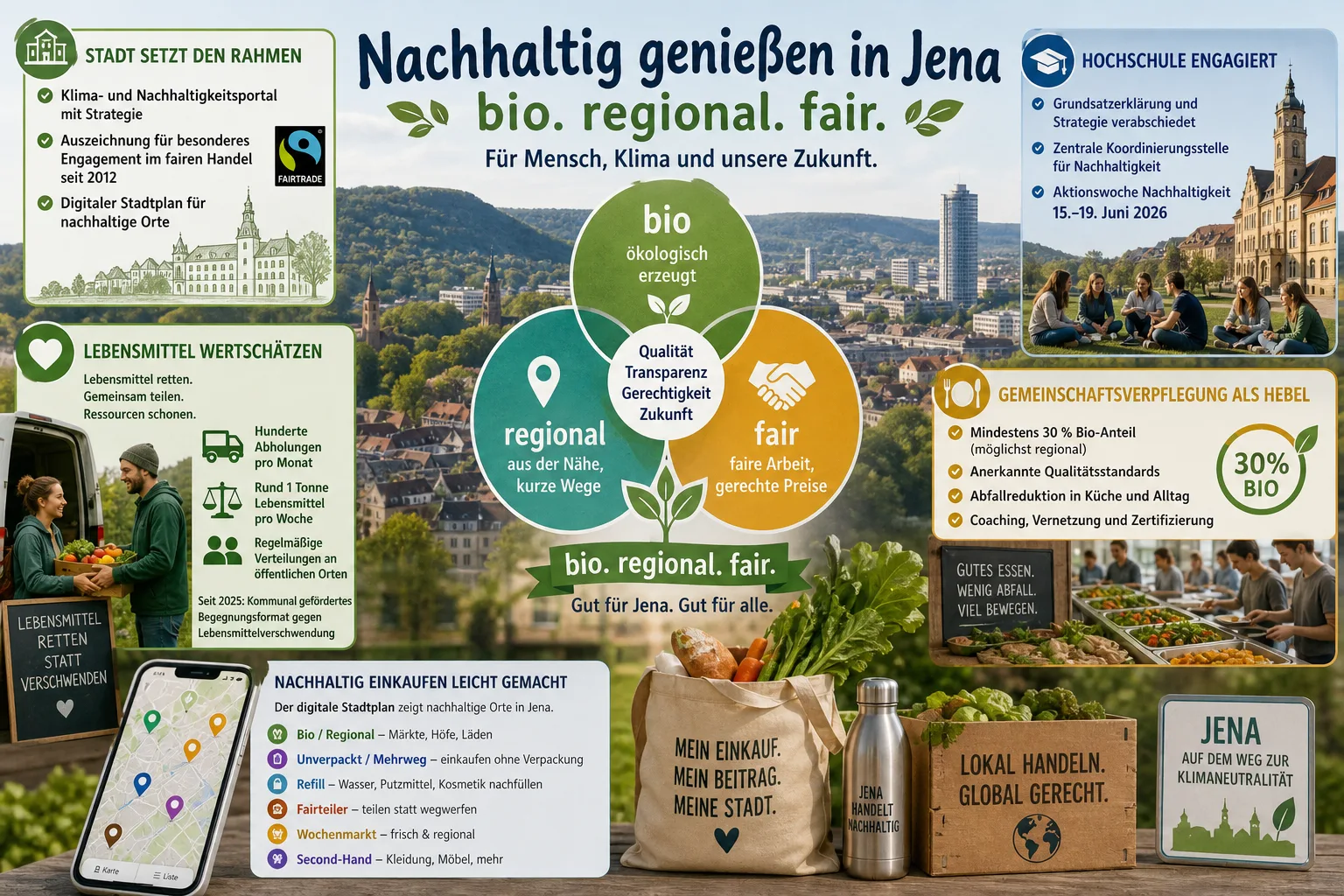
Organic, Regional, Fair: What the Three Terms Will Mean for Your Everyday Life in the Future
To make sustainable enjoyment in Jena practical in the coming months, a clear division helps: Every purchasing decision can cover at least one (and sometimes all three) aspects.
-
Organic:
If you reach for organic products more often in the future, you generally support production methods with stricter requirements regarding chemical-synthetic pesticides and fertilization as well as animal husbandry and feeding (depending on the product category). Pay attention to reliable organic labels (e.g., EU organic logo).
-
Regional:
If you plan seasonally and regionally in the coming weeks, delivery routes are often shorter and origins more transparent. The easiest way is through seasonal shopping lists and direct questions in the store or at the market stand (e.g., “Where does this come from?”).
-
Fair:
For products that you cannot source regionally in Jena in the long term (e.g., coffee, cocoa, tea), “fair” is a practical compass. Look for credible standards and traceable seals (e.g., Fairtrade) – and prioritize products that also offer transparency about the supply chain.
Decision rule for your next purchases: If you only want to optimize one thing, start with “organic” for products that require intensive treatment (e.g., fruit/vegetables, when available) and add “fair” for typical import products. You can reliably achieve “regional” through seasonal planning.
Digital Orientation: How to Soon Find Suitable Places in Jena
In the next few days, you can build a digital routine: do a quick research once, then decide faster in everyday life. A map or portal that bundles sustainable offers by category is particularly helpful. When using it, pay attention to these filters, as they lead directly to measurable everyday benefits:
- Organic / regional (for planned weekly shopping)
- Reusable / unpackaged (for less waste with standard assortments)
- Refill (for tap water on the go, fewer disposable bottles)
- Second-hand / repair (for resource conservation beyond food)
If you want to search specifically for Jena, preferably use official entry pages (city/university) or reputable directories and check whether entries are up to date (opening hours, offers, payment methods). Also, plan a “test week”: deliberately choose two new places (e.g., a regional shopping point and a reusable option) and then decide what fits permanently into your everyday life.
Appreciating Food: How to Avoid Waste and Support Sharing in the Future
A particularly effective lever for the coming weeks is appreciating food: less spoilage at home, smarter shopping, consistently using leftovers. This is climate-relevant because discarded food is not only waste but also means “co-produced” emissions from cultivation, processing, and transport.
What You Can Implement Immediately (and Without Perfect Planning)
- 2-list method: One list “Must be used up” (fridge) and one list “Really missing” (shopping). Only shop after that.
- Plan a leftover day: Set a fixed day for the next week when you combine leftovers (e.g., vegetable stir-fry, oven tray, soup).
- Use best-before date correctly: Treat the best-before date as a guideline, not a throw-away date (check smell, taste, appearance).
- Cook realistic portions: Start the next two weeks with smaller portions and cook more as needed instead of overproducing “for stock.”
If you want to share or save food together in Jena in the future, orient yourself to transparently organized initiatives that clearly communicate how distribution, hygiene, storage, and responsibilities are regulated. It is crucial that the processes are understandable and food safety is taken seriously.
University & Education: Which Formats You Can Use Next
In an educational city like Jena, sustainable consumption becomes particularly tangible when knowledge and everyday life come together. For the coming semesters and action periods, it is worth specifically looking for formats that practically translate nutrition, climate, and supply chains.
This Is How You Proceed Concretely in the Next Weeks
- Calendar check (15 minutes): Look for university-related lectures/workshops on sustainable nutrition, climate, or supply chains.
- Choose a practical format: Decide on a format with an action component (cooking workshop, canteen dialogue, excursion, repair/exchange event).
- Set a mini-goal: Derive a goal for 30 days from it (e.g., “a fair hot drink as standard,” “a regional seasonal vegetable per week,” “no disposable bottles”).
If you want to initiate something yourself, it will be particularly effective in the future if you combine science (e.g., climate impact, nutrition studies) with concrete shopping and cooking decisions. This way, sustainability does not remain abstract but becomes routine.
Canteens, Daycare Centers, Mensas: What to Pay Attention to and What You Can Initiate in the Future
In the coming years, communal catering will remain a central lever because many meals are bundled there. For you as a guest, parent, employee, or student, there are two effective starting points in the short term: demand and transparency.
Questions You Can Ask in the Future (Without Polarizing)
- Is there a transparent origin labeling (regional/organic/fair) on the menu?
- What reusable options are there for to-go?
- How is food waste measured and reduced (portion sizes, pre-ordering, serving system)?
- Who are the suppliers and what criteria are used to select them?
If you want to support changes, start with a suggestion that can realistically be implemented in the next few weeks (e.g., a clearly labeled organic/regional dish per day, a binding reusable system, a monthly feedback appointment). Small, consistent steps are often more sustainable than big announcements without implementation.
Concrete 14-Day Plan for Jena: Small Steps That Remain Realistic
To ensure that “organic, regional, fair” does not remain vague, a short, plannable period helps. This 14-day plan is structured so that you can implement it flexibly in Jena – regardless of where you specifically shop or eat.
- Day 1–2: Define your standard products (e.g., coffee/tea, milk/oat drink, bread, vegetables) and decide which of them you will immediately switch to “organic” or “fair.”
- Day 3–4: Plan two seasonal dishes for the coming week and shop specifically for them (regional, if available).
- Day 5–7: Switch to a reusable routine (own bottle/cup/box). Goal: No disposable to-go packaging this week.
- Day 8–10: Introduce a fixed “leftover day” and briefly document what was not thrown away as a result.
- Day 11–12: Find a new, sustainable offer in Jena (via official pages/directories) and try it once.
- Day 13–14: Decide which two measures you want to keep permanently (e.g., fair coffee + leftover day).
This way, a routine is created in two weeks that you can then expand without making your everyday life more complicated.
Outlook: Which Developments Would Make Sense Next in Jena
If Jena wants to further strengthen sustainable enjoyment in the coming years, from an E-E-A-T perspective (practical, verifiable, trustworthy), three development lines in particular make sense:
- More transparency: clearer, publicly traceable criteria for organic/regional/fair shares in public institutions and at events.
- Better findability: bundled, maintained digital overviews with categories, update date, and contact options.
- Measurable waste reduction: programs that record and reduce food waste and regularly publish the results.
For you as an individual, the next step is simple: In the future, don’t aim to consume “perfectly,” but consistently better – and make decisions so that they remain feasible for you in the long term.