Political Discussions & Talks in Jena – Community & Network
Political Discussions & Talks in Jena: What Will Be Negotiated on the Streets and Online in the Coming Months
In Jena, political debates will continue to take place on two stages in the near future: in public spaces (e.g., through registered rallies, information stands, and vigils) and in the digital space (e.g., via local participation platforms, social media, and media education formats). This overview describes which formats can be expected in the future, how you can prepare, and how to find reliable information, without inventing specific dates.
2. Regulars’ Tables, Panels, Readings: Small Formats with Big Impact
In addition to large street events, small, regular discussion formats will continue to play an important role in Jena in the near future: party-political or civil society regulars’ tables, discussion evenings, lectures, workshops, readings, and campus events.
Why These Formats May Be Influential in the Future
- Lower Entry Barriers: In smaller groups, questions are often more concrete, and follow-up questions are more likely than at large rallies.
- Agenda Setting: Topics such as migration, internal security, social justice, education and science policy, or municipal finances are often framed in regulars’ table formats in such a way that they later reappear in the city’s public sphere.
- Polyphony as an Antidote: A vibrant debate culture will develop where different formats exist in parallel and where rules for fair discussions apply (letting others finish, naming sources, no dehumanization, no threats).
If you want to initiate conversations yourself, in the coming months formats that ensure moderation and transparency will be particularly suitable: clear information about organizers, thematic guiding questions, time for the audience, and a willingness to allow different perspectives.
3. Disinformation & Digital Debate Culture: What Upcoming Talks Will Focus On
In Jena, future political discussions are likely to take the digital dimension even more into account: disinformation, hate speech, algorithmic amplification, and the question of how communities can argue online without escalating.
What Content You Can Expect at Future Events
- Mechanisms of Disinformation: How false claims are spread (emotion, speed, repetition), how manipulated media are created, and why corrections often achieve less reach.
- Practical Verification Methods: Reverse image search, context checking, source hierarchy (primary source before secondary source), date/location/author, and the difference between opinion and factual claim.
- Moderation & Community Rules: What rules online groups can agree on (e.g., source requirement for factual claims, zero tolerance for calls to violence, protection of those affected) and when moderation should escalate (deleting, blocking, reporting).
- IT Security in Everyday Life: Account protection (passkeys/2FA), phishing detection, secure device updates, and handling compromised accounts.
For the coming months: The more debates take place online, the more important it will be for participants to disclose their information basis (source, date, context) and for organizers to teach methodological skills instead of just exchanging opinions.
4. Online Participation in Jena: What Is Likely to Be Discussed Next on Platforms
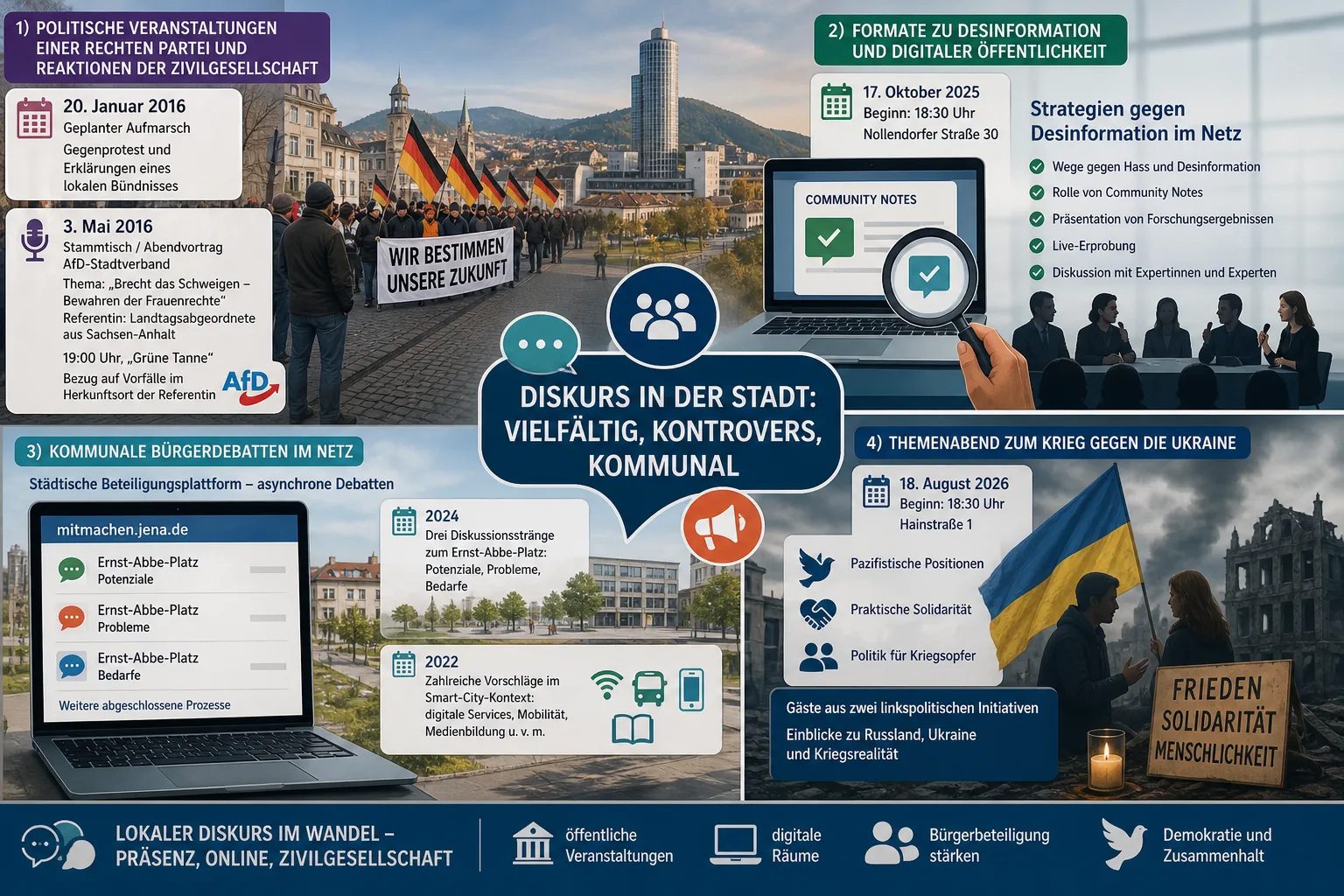
Municipal online participation is expected to continue gaining importance in Jena in the near future. Digital participation spaces make it possible to contribute suggestions and criticism asynchronously—that is, regardless of time, place, and the volume of in-person formats.
Topics That Will Typically Recur in Upcoming Participation Rounds
- Urban Development & Public Space: Quality of stay, diversity of use, cleanliness, lighting, sense of security, noise, and accessibility.
- Mobility: Pedestrian and bicycle traffic, public transport connections, delivery traffic, parking management, school routes.
- Digitalization & Smart City: Reporting systems, open data, digital services, media education, digital participation.
- Climate Resilience: Heat protection, greening, rainwater management, shading, climate-adapted construction.
For online participation to build trust in the future, participants will pay particular attention to whether processes are transparently documented (interim results, considerations, responsibilities) and whether results are visibly reflected in planning, pilot projects, or decisions.
5. Flight, Peace, Climate: How Global Crises Will Be Negotiated in Jena in the Future
In the coming months, political talks in Jena are likely to continue to deal with topics that go far beyond the city limits—and yet are felt locally.
What Might Be Discussed Particularly Frequently in the Future
- Flight & Migration: Municipal integration, accommodation, language and educational opportunities, labor market integration, coexistence in neighborhoods, and dealing with polarization.
- Peace & Security: Civil conflict resolution, solidarity with those affected by war, local support systems, disinformation in the context of international conflicts.
- Climate Change & Transformation: Energy, transport, heat planning, adaptation to heat and heavy rain, goal conflicts between growth, housing, and climate protection.
These topics will be negotiated particularly constructively in upcoming debates when contributions distinguish between values (What is important to us?), facts (What is proven?), and options for action (What can the municipality actually decide?).
6. Practice: How to Participate Safely, Informed, and Constructively
Before an Event or Demonstration
- Check Information: Pay attention to organizer, location, time, route, access, and possible restrictions. Use official or reliably traceable information.
- Clarify Your Own Goal: Do you want to listen, ask questions, show your position, mediate, or document? The clearer the goal, the calmer the participation will be.
- Digital Hygiene: Keep accounts secure (2FA), check links, and do not share unchecked breaking news.
During a Talk or Online Debate
- Name Sources: For factual claims, date, location, and primary source are crucial.
- Ask Questions Instead of Assigning Labels: Follow-up questions ("What is this based on?") are usually more de-escalating than labels.
- Respect Boundaries: No doxxing, no threats, no dehumanization—such content will have to be consistently sanctioned in reputable spaces in the future.
After the Event
- Record Results: Note key points, open questions, and concrete next steps.
- Further Sources: Read primary texts (decisions, studies, original statements) before sharing conclusions.
- Strengthen Dialogue Spaces: Support formats that ensure moderation, transparency, and diversity of perspectives.
Note: This text provides guidance for upcoming discussion and participation formats. It does not replace legal advice or on-site safety instructions.
Sources
- City of Jena (official website) — municipal information & notices (accessed 2026-10-14)
- Mitmachen Jena (participation platform) — online participation & discussions (accessed 2026-10-14)
- Federal Agency for Civic Education (bpb) — background knowledge on politics, media & debate culture (accessed 2026-10-14)
- Federal Office for Information Security (BSI) — IT security, protection against phishing & account security (accessed 2026-10-14)
- European Commission: Code of Practice on Disinformation — framework on disinformation & platform responsibility (accessed 2026-10-14)