Social Projects and Engagement Moving Jena
Social Projects & Initiatives Moving Jena in the Coming Months
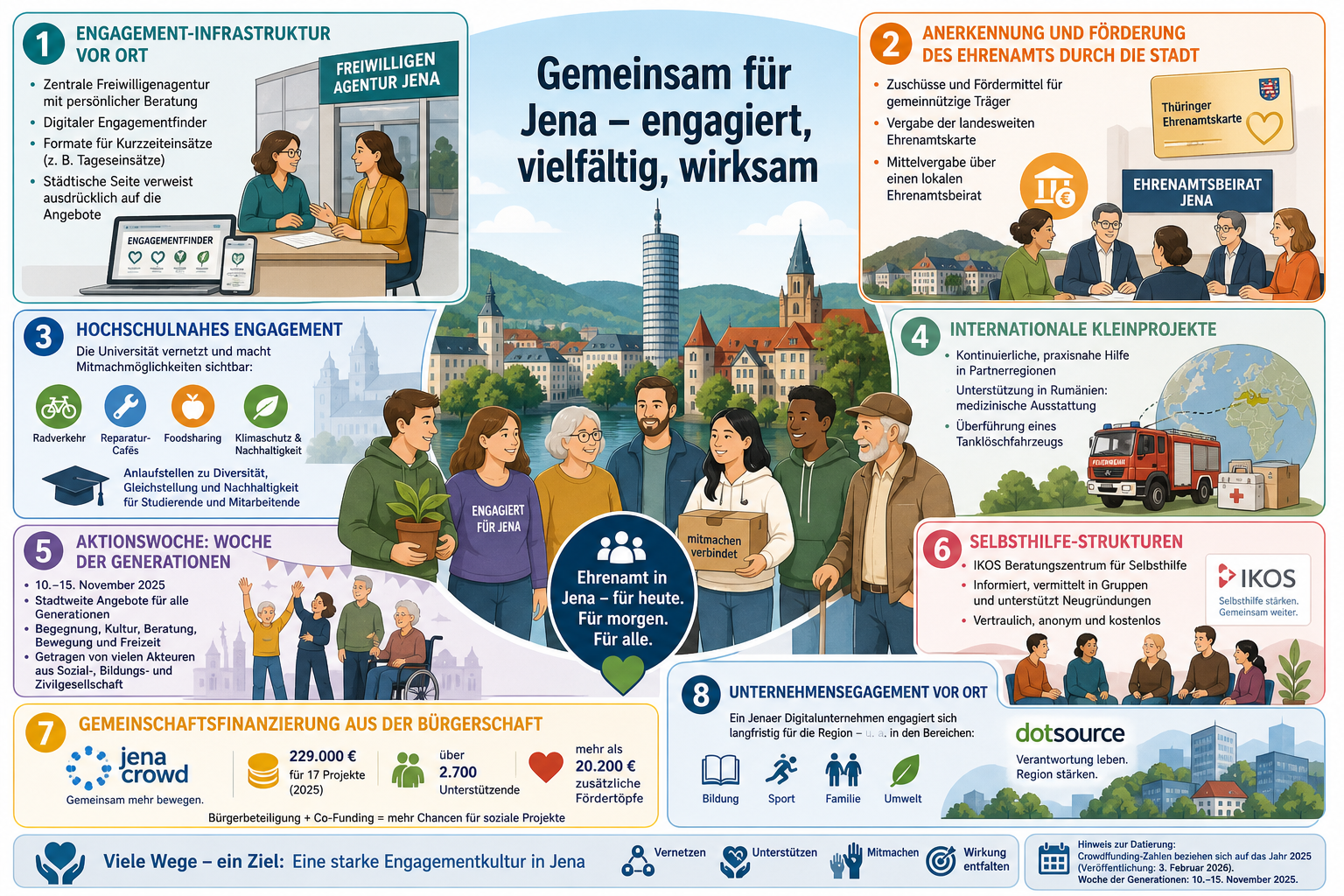
What opportunities will soon be available in Jena to get involved in a meaningful way—short-term, regularly, or project-based? This overview shows upcoming ways to get engaged: through the volunteer agency, municipal funding and recognition offers, university-related initiatives, self-help, as well as formats like action weeks and crowdfunding.
Why Now: Engagement as a Topic for the Future in Jena
In the coming months, voluntary engagement in Jena will be especially noticeable where people quickly need reliable support: in neighborhoods, in communities, in educational and environmental projects, in supporting families, in self-help, and in initiatives that conserve resources. At the same time, it will become easier for many to find the right entry point at all—because Jena relies on structures that bundle mediation, counseling, and cooperation.
If you are currently asking yourself, "Where can I help meaningfully without overwhelming myself?" or "How do I find a project that fits my time budget?", the next steps in Jena are usually clear: use a central contact point, choose a suitable format (one-time, project-based, or regular), and get transparent information about the applicable framework conditions.
1) Finding Engagement: Volunteer Agency & Online Engagement Finder
What Will Be Especially Helpful in the Coming Months
The fastest way into a suitable volunteer position in Jena is through a central volunteer agency with counseling services and digital mediation. For the coming months, this is especially practical for two reasons:
- Planning: You can specifically search for time slots (e.g., "one-time," "evenings," "on weekends") and topics (e.g., education, environment, culture, neighborhood).
- Low Entry Barrier: Those who do not yet have a network in clubs or initiatives receive support in sorting out their own interests and possibilities.
How to Use the Engagement Finder Effectively in the Future
- First filter by time budget (e.g., 2–3 hours/week vs. project action), so that the plan remains realistic.
- Select a target group (children/youth, seniors, people with disabilities, neighborhood, nature and climate protection).
- Check requirements (briefing, qualification, if applicable, extended police clearance certificates for activities with minors).
- Make contact and specifically ask about start options in the coming weeks.
Many municipalities also refer to central mediation offices via their information pages. This is an important signal of trust for volunteers: Engagement is not "privately organized" but is structurally supported and considered in the long term.
2) Recognition & Funding: What Will Be Important in the Next Application Rounds
For an idea to become a viable social project, more than motivation is often needed in the coming period: spaces, materials, insurance issues, public relations—and often also seed funding. In Jena, municipal funding opportunities and local committee structures are relevant for this.
Funding: What Initiatives Should Prepare for in the Future
- Plan early: Anyone who wants to start a project in the coming months should check early which application deadlines apply and which documents are needed.
- Make goals & impact understandable: Good applications briefly explain for whom the project is, what specifically happens, and how success will be measured (e.g., number of participants, regular dates, cooperations).
- Transparency in costs: A plausible cost plan (even for small amounts) increases the chances of approval and builds trust.
Recognition: Why Appreciation Matters for the Future
Engagement remains more stable in the long term when it is visibly recognized. In Thuringia, the Volunteer Card plays a central role because it combines benefits and public appreciation. For many volunteers, it is not the main reason, but an additional incentive—and a sign that voluntary work is considered a social achievement.
Qualification: Skills for the Next Project
In the coming months, training on the following topics will be especially useful—because they make projects more resilient:
- Project organization (roles, tasks, time planning)
- Public relations (texts, social media, press contact)
- Law & safety in volunteering (supervisory duties, data protection, liability—each depending on the activity)
Note: Specific requirements and responsibilities differ depending on the sponsor and activity. Binding information is provided by the respective offices and official information pages.
3) Campus & City: University-Related Engagement (Upcoming Semesters & Project Entries)
With the coming semesters, new entry opportunities into university-related initiatives regularly arise in Jena—especially for people who need to remain flexible (exam periods, part-time jobs, internships). Universities and university environments often bundle information, refer to local projects, and make engagement visible.
Which Formats Will Likely Fit Especially Well
- Sustainability & Repair Formats: Participation offers where things are repaired together and resources are conserved.
- Food Rescue: Initiatives that distribute surplus food or build structures against waste.
- Mobility & Environmental Education: Projects that support safe routes, climate-friendly mobility, or local environmental education.
This is relevant for the city's future: Those who make early contacts in the urban community are more likely to remain engaged in the long term—even beyond their studies. For volunteers, skills are developed that are also helpful professionally: teamwork, conflict resolution, responsibility, and organization.
4) Beyond Jena: International Solidarity as Upcoming Participation Projects
In the coming months, there will continue to be opportunities in Jena to practically support international solidarity—for example, through information events, material and donation campaigns, or cooperations within the framework of municipal partnerships. Such projects are particularly trustworthy when goals, recipient structures, and logistics are transparently documented.
How to Recognize Serious International Participation Projects
- Clear responsibilities: Who organizes, who coordinates on site, who reports?
- Transparent use of funds: What costs arise (e.g., transport, storage, training), where do funds go?
- Understandable impact: What specific improvement is being sought (e.g., equipment, training, infrastructure)?
If you want to get involved but are unsure, start with a small, verifiable contribution (e.g., helping at an event, sorting materials, communication support) and have the processes explained to you. This is a good basis for taking on more responsibility later.
5) Self-Help, Action Weeks & Crowdfunding: Formats Starting Again Soon
Self-Help: Confidential Ways That Can Support in the Coming Weeks
Self-help is an important part of social support in Jena—especially in phases when people are seeking orientation or dealing with a stressful situation for the first time. Counseling services and self-help structures typically help in three steps:
- Initial counseling (confidential, low-threshold)
- Mediation into existing groups or suitable contacts
- Support for new groups (organization, rules, spaces, moderation)
If you want to build a group yourself, it makes sense to seek support early—so that responsibilities are clear and the offer remains stable in the long term.
Action Weeks: Why Visiting Will Be Especially Worthwhile in the Future
Citywide or district-based action weeks usually lower the threshold: You can get to know offers without committing immediately. In the coming rounds of such weeks, the following is especially helpful based on experience:
- choose a date that is close to your own place of residence,
- choose a format that enables encounter (open meetings, workshops, counseling),
- ask directly on site about participation opportunities starting the following month.
The current programs, locations, and times are usually published via official city, sponsor, or network pages.
Crowdfunding: Making Future Project Starts Possible Together
Local crowdfunding will remain especially relevant in the coming months for initiatives that want to start quickly but do not (yet) have classic funding structures. For supporters, crowdfunding is a transparent way to specifically enable a project in Jena—often with a clearly defined target amount and project description.
If you are planning a project yourself, these factors increase the chances of success:
- Concrete, manageable goal (e.g., equipment, room rental for a pilot phase, materials for workshops)
- Understandable timeline (kick-off, implementation, final report)
- Transparent communication during the campaign (interim status, budget, next steps)
6) Business & Civil Society: Trends That Will Shape the Future
In the coming years, three developments are likely to be particularly important in Jena:
- More cooperation with businesses: Time donations, know-how transfers (e.g., IT, communication, project management), and joint action days can relieve initiatives—if expectations are clearly regulated.
- Digitization with a sense of proportion: Online coordination, digital consultation hours, or hybrid events lower barriers; at the same time, personal encounters remain central to building trust.
- Focus on reliability: Projects that clearly regulate responsibilities, data protection, and quality assurance will be more stable in the long term—and more attractive to new volunteers.
For volunteers, this means: It will become easier in the future to find "the right format"—whether as one-time support, as a regular task, or as a co-founder of a new offer. The key is to choose a model that fits your everyday life and remains sustainably feasible.
How to Get Started in the Next 7 Days (Practical Plan)
- Day 1–2: Decide on a time budget (e.g., one-time / monthly / weekly) and a topic.
- Day 2–3: Use a central mediation office (volunteer agency/engagement finder) and choose 2–3 suitable options.
- Day 3–4: Contact the projects with a short, specific message: time window, motivation, start date.
- Day 5–7: Arrange a meeting. Ask about briefing, insurance/liability, data protection, and clear tasks.
If you work with people in sensitive life situations (e.g., children/youth, care, counseling), clarify in advance which formal requirements apply. Serious sponsors explain this transparently.
Note (not legal advice): This article is for orientation and does not replace individual counseling by the responsible offices or sponsors.