Discover the Tech Meetup & Hackathon Scene in Jena
Tech Meetups & Hackathons in Jena: How a Digital City Codes Together
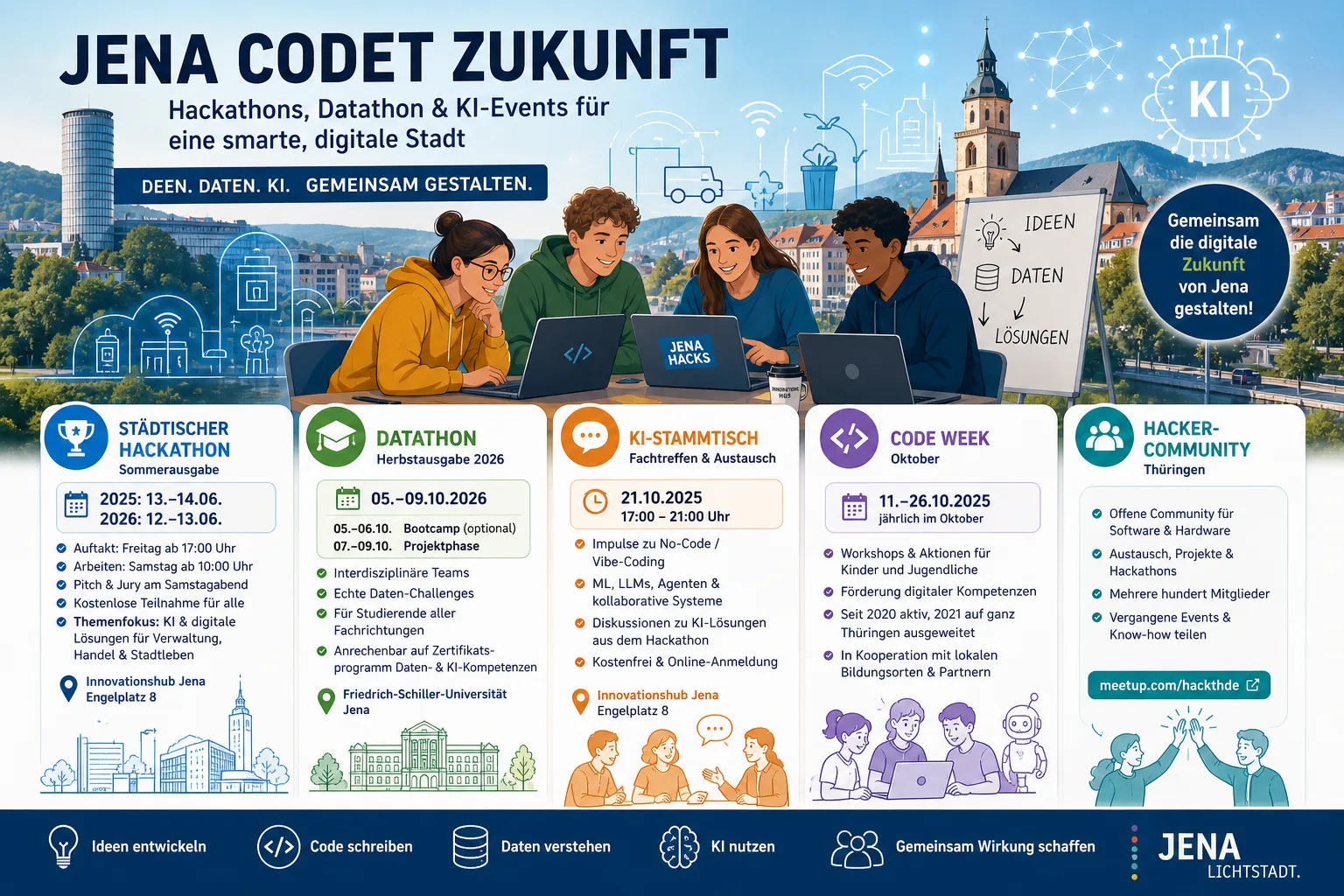
Throughout the year, Jena offers formats where administration, universities, companies, and civil society work on digital ideas: a city-driven Smart City Hackathon (typically in summer), a university Datathon (often in autumn), regular tech meetups, and Code Week (in October). This overview helps you find suitable events, prepare well, and realistically assess what to expect both technically and organizationally.
Smart City Hackathon: Prototypes for the City
A Smart City Hackathon in Jena is typically planned as a compact weekend format: In a short time, teams develop digital prototypes that address concrete challenges in the urban context. The focus is not on perfect product maturity, but on a comprehensible, testable approach.
Process you can expect at similar municipal hackathons
- Kick-off & Challenges: At the beginning, problem statements are presented (e.g., processes, services, mobility, energy, citizen communication).
- Team formation: You can come alone; teams usually form around interest (use case) and roles (dev, data, design, domain knowledge, presentation).
- Build phase: Work on the prototype, often with mentors for software development, UX, data analysis, and project structure.
- Pitch & Feedback: Short, clearly structured presentations with follow-up questions; often, usefulness, feasibility, data protection/IT security in the approach, and quality of validation count.
Typical topics (future-oriented, without exaggerated promises)
- Sensors & IoT (e.g., energy-saving controls or environmental data) – especially relevant when open standards and robust measurement concepts are used.
- Data-based planning (e.g., utilization, routes, resources) – meaningful when data sources, assumptions, and uncertainties are transparently documented.
- Citizen-friendly interfaces (e.g., chat or voice interfaces for city information) – important: clear language, accessibility, and clear boundaries of what can be answered automatically.
- AI prototypes – convincing when data protection, bias risks, and human oversight are considered from the start.
What “good output” realistically means in 24–48 hours
A strong hackathon contribution mainly shows: (1) the problem is clearly defined, (2) the prototype runs in a demo or on test data, (3) central risks (data quality, data protection, security, operation) are identified, (4) the next steps are prioritized. This is often more valuable than a feature-rich but fragile solution.
Datathon: When Data Comes Alive
A datathon format in Jena is usually multi-day and combines learning with project work. Unlike the classic hackathon, the focus here is on methodological quality: clean data preparation, comprehensible modeling, and honest interpretation of results.
Typical structure
- Bootcamp phase: Workshops on data cleaning, visualization, basics of machine learning, evaluation, and reproducibility.
- Project phase: Teams work on a concrete question; important are data documentation, version control, and a clear results report.
- Final presentation: In addition to metrics, plausibility, robustness, limits of significance, and ethical aspects count.
What you should pay attention to as a participant (quality criteria)
- Traceability: Which data was filtered, cleaned, and transformed and how?
- Evaluation: Does the metric fit the question (e.g., classification vs. regression), and was a meaningful separation of training and test data used?
- Fairness & bias: Are there systematic biases (e.g., in training data) that make the result unusable or unfair?
- Data protection: If personal data is involved, purpose limitation, minimization, and access controls must be clarified very early.
Especially for students and career changers, a datathon is a good entry point because roles are diverse: data preparation, visualization, domain understanding, modeling, documentation, and presentation.
Tech Meetups & AI Roundtable: Everyday Exchange
Between the major annual formats, regular meetups are often the most reliable entry point. They offer short impulses (e.g., on LLM workflows, MLOps basics, open data projects, or IT security) and then open exchange.
What you can take away
- Realistic insights: What really works in everyday project life – and where do AI or data ideas fail due to data access, quality, or operations?
- Find partners: Those who later collaborate at hackathons or datathons often first meet in the meetup context.
- Low-stakes learning: You can ask questions without having to “deliver.”
How to prepare (even without prior knowledge)
- Write down 1–2 questions you really want to clarify (e.g., “Which tools do you use for data pipelines?”).
- If you have a project: bring a 60-second explanation (problem, target group, current status).
- Respect confidentiality: Not every project practice is intended for public channels.
Code Week: Young Talent for the Digital City
Code Week takes place annually in October and bundles workshops and hands-on activities for children and young people. In Jena, such formats can take place at schools, libraries, youth centers, or near universities. The content usually focuses on first programming experiences, creative projects, robotics, or simple sensors.
Why this is strategically important for Jena
- Early participation: Digital competence arises through trying things out – not just through theory.
- Understanding instead of consumption: Those who build technology themselves can later better assess how AI and data influence everyday life.
- Talent pipeline: Young people can later more easily grow into larger formats (e.g., project groups, datathons, hackathons).
Why Participating is Worthwhile
-
Concrete contribution:
City-related challenges bring focus: Instead of “just any app,” you develop something that can provide value in a municipal or regional context.
-
Learning in the project:
You apply knowledge directly (data, UX, APIs, prototyping, presentation) and get immediate feedback.
-
Network:
You meet people with complementary skills. For many, this is the fastest way to new collaborations or a next project.
-
Low barriers:
Meetups and many community formats are often free of charge; at hackathons, motivation and teamwork usually count more than perfection.
-
Orientation:
You find out whether you are more drawn to data/ML, software, product, design, or project organization – without long-term commitment.
Practical Preparation: Checklists
For Hackathon Participation (24–48 hours)
- Clarify goal: Demo-ready prototype, not product maturity.
- Team roles: At least 1 person for presentation/story, 1 for implementation, 1 for user perspective/UX (one person can take on multiple roles).
- Technology: Laptop, charger, power strip, mobile internet as fallback.
- Scope: One use case, one core function, one test scenario.
- Responsibility: Do not “just import” sensitive data; work data-efficiently.
For Datathons (multi-day)
- Documentation: Reproducible notebooks/scripts, clear data description.
- Evaluation: Define baseline model, then improve.
- Interpretation: Openly state result limitations (uncertainty, bias, data gaps).
- Communication: Simple visuals and understandable explanations beat pure metric tables.
Sources
- EU Code Week (official website) — Information on timing, formats, and participation opportunities (accessed 2026-10-07)
- European Commission: Digital Strategy — Context on digital skills and digital ecosystems (accessed 2026-10-07)
- Federal Office for Information Security (BSI) — Principles and materials on IT security, relevant for prototypes and later implementation (accessed 2026-10-07)
- GDPR.eu (overview of GDPR, secondary source) — Explanation of key data protection terms; the regulation text remains authoritative (accessed 2026-10-07)
- EUR-Lex — Official access to EU legal texts (e.g., GDPR in original) (accessed 2026-10-07)