Experience Improv Theater & Performance Art in Jena
Improv Theater & Performance Art in Jena: What Awaits You in the Coming Months (and How to Join In)
When a city plays, dances, whispers, and laughs without a finished script, a special moment arises: theater becomes something that grows in the here and now. For Jena, numerous opportunities are once again being announced in the coming months where improvisation, performance, and theater pedagogy formats find their way from rehearsal rooms into the public.
Where You Can Experience It in Jena in the Future: Venues & Formats
For the upcoming season and semesters, several tracks are expected to be relevant in Jena. Instead of committing to a single stage, it’s worth looking at format types, because improv and performance often take place at changing locations:
1) Theater House Formats with a Free Handwriting
In program announcements from municipal venues, there will repeatedly be evenings that work experimentally: ensemble productions with guest artists, play developments, performative lectures, or evenings where music, light, movement, and text stand side by side as equals. For you as an audience member, this means: you can expect evenings that define themselves less by "plot" and more by experience, rhythm, and rules of play.
2) Small Stages, Projects, and Off-Formats
In the coming months, project evenings will also be announced again and again, taking place in smaller rooms, studios, or temporary venues. These formats are often more short-term, personal, and experimental. If you want to experience improv or performance for the first time, you’ll often find a low-threshold entry here.
3) Workshops & Presentations from Courses
A reliable anchor point will continue to be public final presentations from courses and workshops. Here, it’s often not "the perfect play" that’s shown, but a result from exercises, scene studies, and improv structures—often with direct audience address.
Summer Formats in Urban Spaces: When Performance Becomes Public
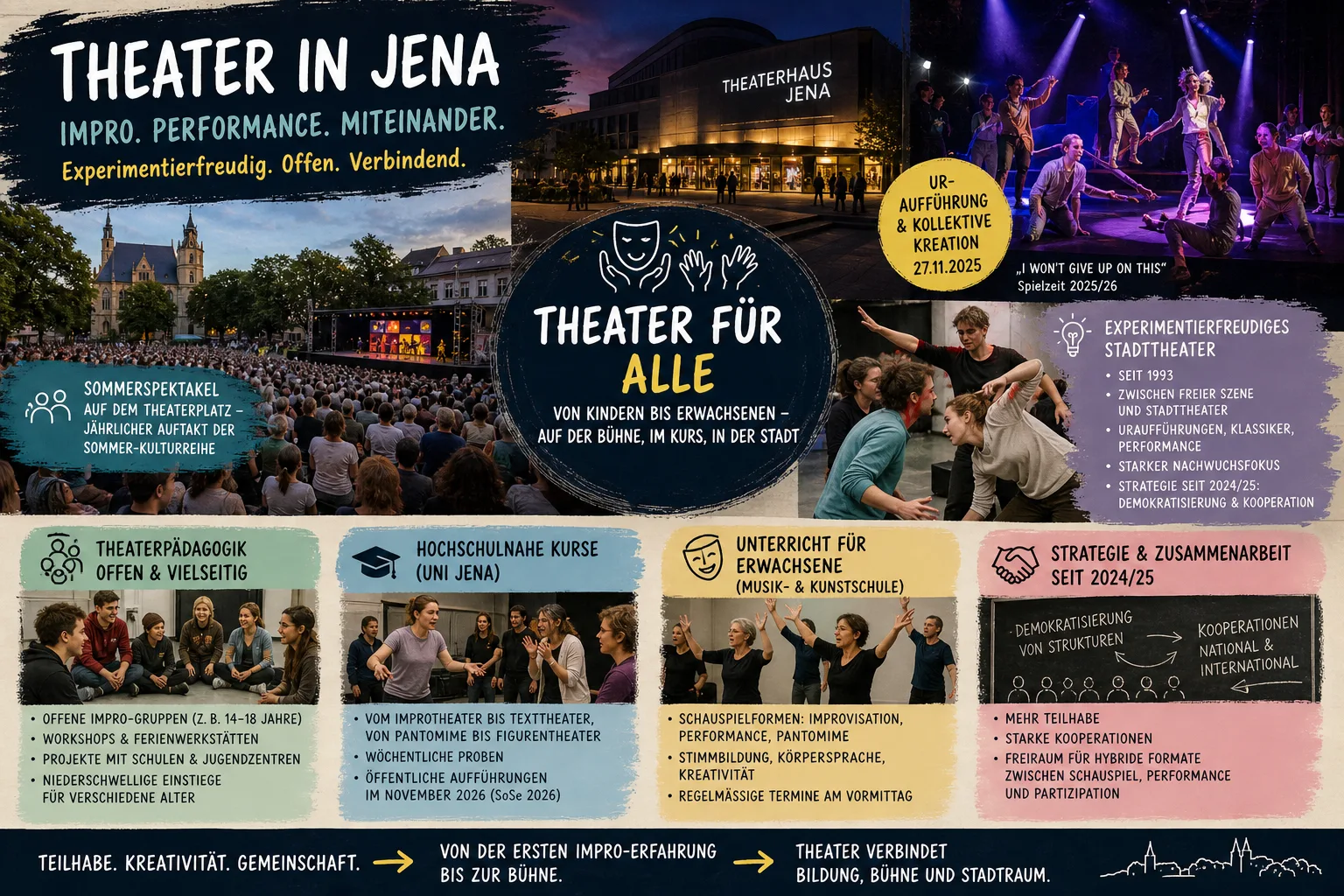
For the summer, cultural formats are often announced in Jena that use urban spaces as a stage (e.g., on squares around central cultural venues). At such events, you can expect the following elements in the coming months:
- Open scenes that arise without a clear "starting point" and involve passersby.
- Live music or soundscapes that structure improv scenes (tempo, moods, transitions).
- Movement and choreographic sequences that are told more through images than dialogues.
- Interaction, where audience suggestions, spaces (stairs, cafés, paths), and everyday situations become the basis for play.
If you want to attend such summer formats, it’s best to plan flexibly for future dates: these events often have the strongest impact when you arrive without time pressure, take in several short scenes, and allow yourself to experience changing perspectives.
Workshops & Theater Pedagogy: Entry from Childhood to 60+
In the coming months, workshops and theater pedagogy offerings are expected to be announced again in Jena, using improvisation as a space for learning and experience. Such formats are typically organized by age group and goals:
- Children: playful basics (body, voice, space), short scenes, imagination work.
- Youth: improv rules, teamwork, character and status, often with small performances or workshop evenings.
- Adults: improv as communication and presence training, scene work, sometimes also pantomime/physical theater and performance elements.
- 60+: gentle entry through movement, voice, storytelling, and group exercises; the focus is often on joy, encounters, and mental agility.
For future calls for applications, it is crucial: good workshops state clearly whether prior experience is needed, how large the group will be, what the goal is (pure exercise vs. presentation), and how boundaries are handled (e.g., physical proximity, sensitive topics, participation in interaction).
If you want to participate yourself, pay attention to notes on accessibility, changing facilities, photo/video rules, and whether you should bring sportswear or neutral play clothing when registering.
University & College Sports: Courses with Rehearsal Rhythm and Final Presentation
For upcoming semesters, theater and improv courses are often offered at universities as part of college sports or cultural programs. For Jena, you can typically expect a fixed weekly rhythm:
- Regular rehearsals (usually weekly) with clear exercise goals: responsiveness, character work, scene building, body and voice work.
- Block structure: warm-up, technique/principle, scene exercises, reflection.
- End of semester with a workshop or public presentation, depending on the course profile.
Such courses are particularly suitable for beginners because you get a reliable framework: fixed times, a learning curve over several weeks, and a protected practice setting. If you want to participate as an external person, check the participation conditions early in the next calls for applications (e.g., quotas, fee models, waiting lists).
How to Prepare: Tickets, Participation, Mindset
As an Audience Member
- Admission and start times: Improv and performance evenings often work with short pre-formats. Plan so that you don’t arrive only after the start.
- Seating arrangements: Some formats are announced with changing viewing directions or standing areas. If you have specific needs, choose seats/options accordingly in future bookings.
- Interaction: If an evening is announced as interactive, this usually means: you can be addressed, but you don’t necessarily have to actively participate. Serious formats communicate boundaries transparently.
As a Participant
- Expectation management: In the first sessions, there is rarely "fun, spontaneous play". Usually, basics are trained first (listening, accepting offers, making clear decisions, physical presence).
- Error culture: Improv thrives on using mistakes as material. Good course leaders establish rules that create safety for this.
- Health & boundaries: In future courses, pay attention to warm-ups, breaks, handling proximity, and clear consent in exercises.
Improv is most effective when you play both courageously and kindly: make clear decisions, make others look good, and take the moment seriously.
Joining In Jena: A Concrete 4-Step Plan for the Next Few Weeks
-
Choose your entry point: Decide whether you want to watch first (open stage/workshop) or jump right in (beginner workshop). For many, a short workshop is the fastest start because you can try it out without a long-term commitment.
-
Look for "beginner", "open level", or "no prior knowledge": These terms are most often used in upcoming calls for applications when a format is truly intended for newcomers.
-
Plan realistically: Decide for yourself whether you have time for a single session (workshop) or for regular sessions (course) in the next 6–8 weeks. Improv benefits greatly from continuity.
-
Stick with it and switch formats if needed: If you realize that comedy improv isn’t for you, try physical theater, performance workshops, or text-based scene work in the coming months instead. The scene thrives on diversity—and your suitable format is often a matter of trying things out.